The Kayah are one of the eight major ethnic groups inhabits in the Kayah State (formerly Kayanni or Red Kayin) lying on the eastern slopes of the ranges which are dominated by Mt. Nattaung to the east of Taung Oo and just immediately South of Shan State.
Ethnically, the Kayah belongs to Mon-Khmer linguistic branch of Mongoloid Stock. But they were freely called as Kayinni or Red Kayin since they willingly put on bright red costume. Eventually, the Kayah State in inhabited by many ethnic groups such as Padaung or Kayen, Shan, Geko, Geba, Taungthu, Manu, Manau, Bre, Paku, Yintalaing, Yinbaw and Inntha so on speaking their own languages or dialects.
The Professions and careers of the state are regarded as slash and burn agriculture, gardening, fishing, hunting, pottery and weaving of traditional back-strap, with rich natural resources. The state is constituted by six major Township; such as Demausoe, Frusoe and Pasaung etc.. while Loikaw is the capital and the administrative head-quarter, lied about 90 miles to the south of Taunggyi.
Traditionally, the Kayah usually build stilt-house with only one door on the slopes far from water sources since they believe that habitat by water frequent ill.
The commonest glory of the house is frog-drum and Kuhtoboe or Tagondaing means the banner-post ceremony is accordingly held for 3-7 days in advance of the rain-fall, usually in April.
It is the capital of Kayah State and almost totally unbeaten track for tourists and international travelers. Regarding to the striking red costume, the people and respective region were widely noted as the Red Karen in the colonial period.
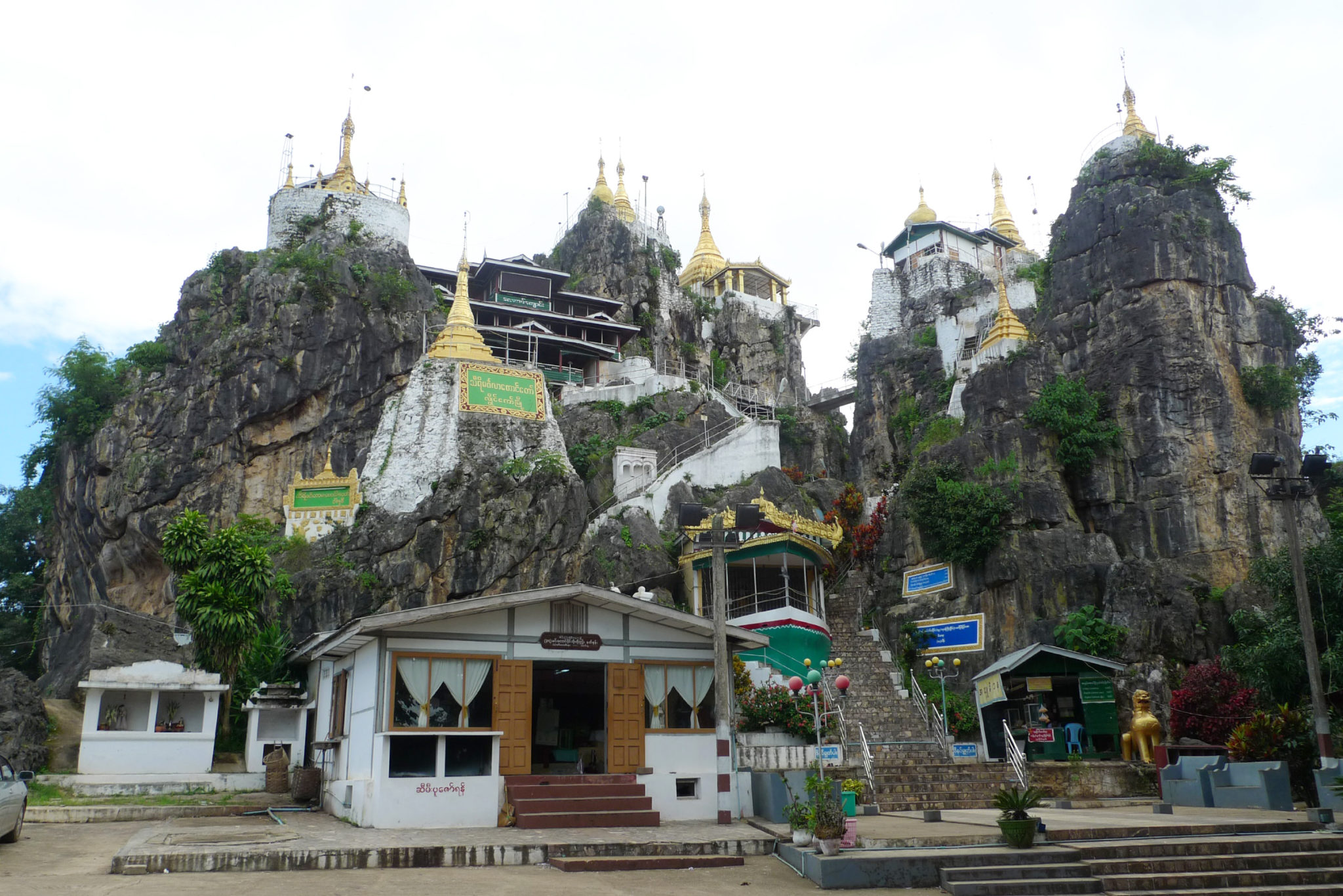
It is highly regarded as the landmark of the town and glory of the region. In conjunction with the split nature of the hillock, it is widely known as Taung-gwe meaning split hill.
A natural lake in the city area is now intentionally shaped to be a beautiful landscape and public recreation center.
A visit point in the small town is nothing else but the cultural museum situated at the corner of 10th Street and Khunni Street. Not accessible to every nook and corner of the region, the museum should be dropped to enjoy a variety of exhibition for ethnic minorities at one place.
According to the legend of Kayah people, it was their earliest habitat site and now merely a rural village but scattered a reasonable number ruined pagodas, monasteries and a scenic lake.
Next to the annual harvest festival, Kaehtopoe meaning setting the banner post and house warming ceremonies are, of course, public functions, and commonly held in April, in advance of rainy season.